



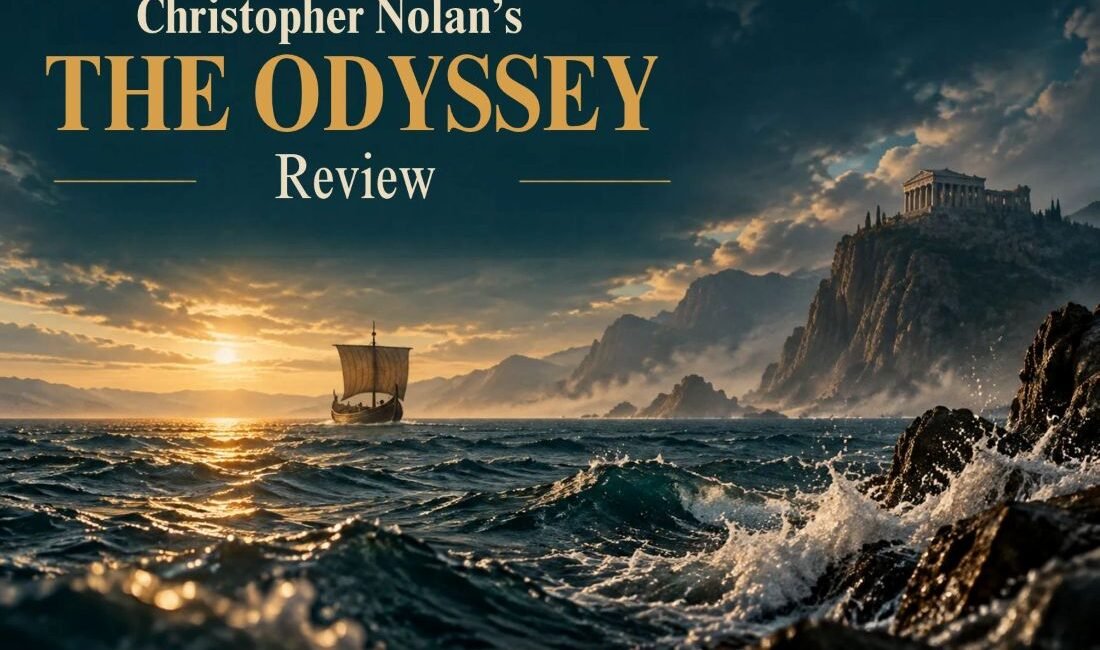
Nolan’s IMAX 70mm take on The Odyssey delivers a towering, tactile analog triumph.

There is a moment early in Christopher Nolan’s The Odyssey where a fleet of wooden ships cuts through a slate-gray Mediterranean squall, lit only by the guttering orange glow of oil lanterns. There are no weightless digital cameras swooping over computer-generated oceans, no sanitized sword-and-sandal gloss. Instead, you feel the salt spray, the creak of wet timber, and the suffocating dread of men entirely at the mercy of nature and the gods. Released in July 2026, Nolan’s R-rated adaptation of Homer’s ancient Greek epic is not merely a blockbuster—it is a towering, tactile triumph of analog filmmaking that easily justifies its status as the undisputed frontrunner for the 2027 Academy Awards.
The Long Road Home
Clocking in at a brisk 173 minutes, The Odyssey picks up in the bitter aftermath of the Trojan War. Ten years after helping topple Troy, Odysseus (Matt Damon), the battle-weary King of Ithaca, wants nothing more than to cross the sea and reunite with his family. However, the whims of capricious deities, violent tempests, and monstrous obstacles turn a routine voyage into a decade-long nightmare of survival and memory.
Rather than telling Homer’s poem in a straightforward linear march, Nolan applies his signature non-chronological storytelling to the myth. The narrative weaves seamlessly between Odysseus’s harrowing encounters—from the suffocating terror of the Cyclops Polyphemus and the haunting allure of the Sirens to his stranded isolation with the enigmatic Calypso (Charlize Theron)—and the mounting political crisis back home in Ithaca. There, Queen Penelope (Anne Hathaway) and her young son, Telemachus (Tom Holland), are trapped in their own palace, besieged by a pack of ruthless, entitled suitors led by the venomous Antinous (Robert Pattinson), all vying to seize the throne and force Penelope’s hand.
Craftsmanship on an Unprecedented Scale
As the first feature film in history shot entirely on IMAX 70mm film cameras, The Odyssey is a breathtaking sensory experience. Cinematographer Hoyte van Hoytema captures the ancient world with a stark, weathered realism that feels closer to Dunkirk than traditional fantasy epics. By filming on rugged, real-world locations across Greece, Iceland, Scotland, and Morocco—and relying heavily on practical sets, real ships, and forced-perspective miniatures—Nolan grounds the mythological elements in visceral physical reality. When monsters appear, such as in the claustrophobic, terrifying Cyclops sequence or the eerie encounter with Samantha Morton’s Circe, they carry the weight and menace of genuine horror.
Equally transformative is Ludwig Göransson’s musical score. Abandoning standard orchestral swells, Göransson builds a primordial, haunting soundscape out of custom-forged bronze gongs, raw vocals, and reconstructed ancient instruments like the aulos and the lyre. Combined with Jennifer Lame’s razor-sharp editing and thunderous sound design, the film turns every crashing wave and clashing shield into a physical jolt.
A Career-Defining Ensemble
While the technical scale is monumental, The Odyssey thrives because of its deeply human performances. Matt Damon delivers what may be the finest work of his career as Odysseus. Stripped of typical action-hero bravado, Damon plays the king as a haunted, resourceful survivor—a man whose legendary cunning is constantly tested by grief, post-war trauma, and the slow erosion of his own memories.
Back in Ithaca, Anne Hathaway brings quiet steel and aching vulnerability to Penelope, transforming a character often sidelined in adaptations into the emotional anchor of the story. Tom Holland matches her with a poignant turn as Telemachus, a young man buckling under the impossible shadow of a father he barely knows. Meanwhile, Robert Pattinson steals every scene he occupies as Antinous, oozing aristocratic cruelty, while Zendaya brings a grounded, luminous presence to the goddess Athena, portraying the divine not as distant marble statues, but as sharp, meddling forces intertwined with human fate.
Myth Through a Modern Lens
Beneath its seafaring spectacle, Nolan’s screenplay—drawing from both Homer and modern translations—interrogates the very nature of heroism and nostos (the ancient Greek concept of homecoming). The film refuses to romanticize the Trojan War, framing the conflict as a ruinous endeavor born from the vanity of petty kings like Agamemnon (Benny Safdie) and Menelaus (Jon Bernthal). By contrasting Bronze Age brutality with the sacred laws of hospitality and human obligation, Nolan turns an ancient poem into a sobering meditation on what war takes from a soul—and what it costs to find your way back.
It is worth noting that The Odyssey is not without minor friction. A handful of purists may balk at the modernized, conversational dialogue—which intentionally avoids archaic accents—and the dense, fragmented opening act requires close attention as timelines and characters rapidly interlock. Yet once the rhythm locks into place, the momentum is unstoppable.
Final Verdict
Christopher Nolan’s The Odyssey is a landmark achievement in modern cinema—a film that marries the intimacy of psychological drama with the awe-inspiring majesty of old-school epic filmmaking. Whether experienced in a packed theater or on a massive screen at home, it stands as an unforgettable odyssey of sight, sound, and spirit, and a worthy heavyweight contender as the 2027 Oscars approach.
Rating: 4.5 / 5
Frequently Asked Questions
-
When was Christopher Nolan’s The Odyssey released and what is its runtime?
Christopher Nolan’s R-rated adaptation of Homer’s ancient Greek epic was released in July 2026. The film runs a brisk 173 minutes and opens ten years after the fall of Troy as Odysseus fights to return home to Ithaca.
-
Who stars in Christopher Nolan’s The Odyssey?
Matt Damon stars as Odysseus, joined by Anne Hathaway as Queen Penelope, Tom Holland as Telemachus, Robert Pattinson as Antinous and Zendaya as Athena. The cast also features Charlize Theron as Calypso, Samantha Morton as Circe, Benny Safdie as Agamemnon and Jon Bernthal as Menelaus.
-
How was The Odyssey filmed?
The Odyssey is the first feature film in history shot entirely on IMAX 70mm film cameras. Cinematographer Hoyte van Hoytema filmed on real-world locations across Greece, Iceland, Scotland and Morocco, relying on practical sets, real ships and forced-perspective miniatures.
-
Who composed the score for The Odyssey?
Ludwig Göransson composed the musical score, building a primordial soundscape from custom-forged bronze gongs, raw vocals and reconstructed ancient instruments such as the aulos and the lyre, paired with Jennifer Lame’s editing.
-
What rating did The Odyssey receive in this review?
The review awards Christopher Nolan’s The Odyssey 4.5 out of 5, calling it a landmark achievement in modern cinema and the undisputed frontrunner heading into the 2027 Academy Awards.
References
- Universal Pictures. The Odyssey (Official Site). https://www.odysseymovie.com/
- Wikipedia. The Odyssey (2026 film). https://en.wikipedia.org/wiki/The_Odyssey_(2026_film)
- IMAX. The Odyssey. https://www.imax.com/movie/the-odyssey