



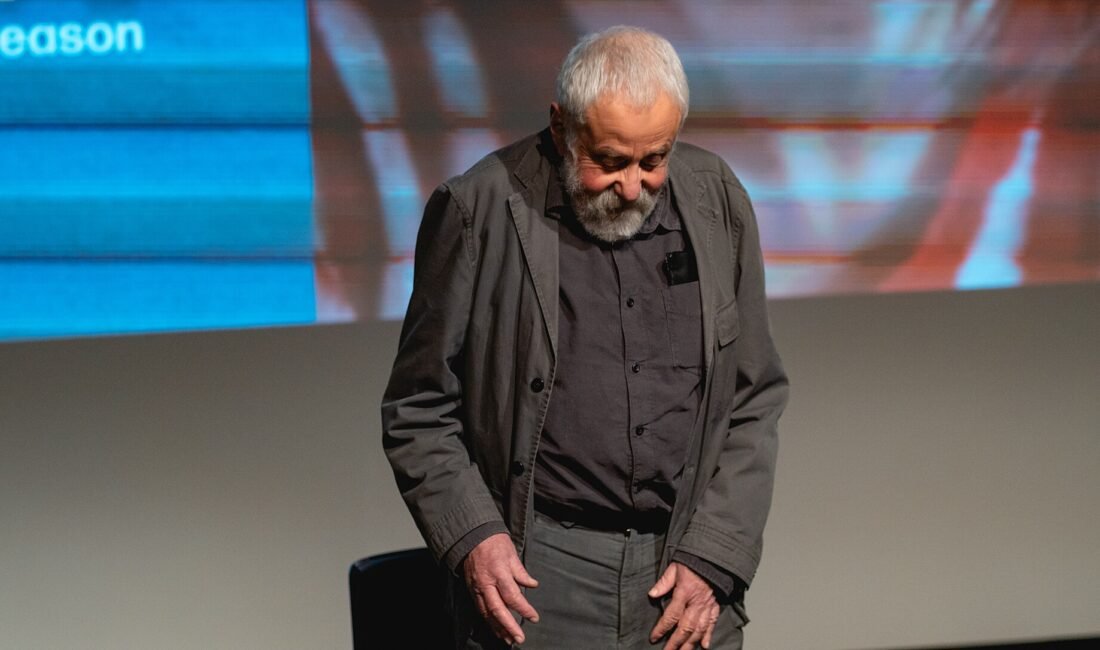
Myositis ends Leigh’s directing days, a farewell after 55 years of films.

Mike Leigh has made his last film: Tender Loving Care will close a directing career that began with Bleak Moments, because myositis has weakened his muscles and put the physical demands of directing beyond him, according to his interview with The Guardian.
A Condition That Changed the Plan
Leigh was 28 when he shot Bleak Moments, his first feature, and he turned 83 on the set of Tender Loving Care, his 17th. He did not know during the shoot that it would be his last. “That’s come this year,” he told the Guardian’s Xan Brooks, explaining that the myositis, an inflammatory condition, “is just slowly getting worse.” The shoot itself went fine, he said; the crew was helpful and he had to be moved around a bit, but mobility has become a bigger problem since.
The interviewer floated workarounds, such as directing through a proxy or from a wheelchair. Leigh shut the idea down with a line that Deadline also picked up: his answer to everyone telling him how he can keep working “begins with an ‘F’ and ends with an ‘off’.” He is not stepping away from creative life entirely. “I’m going to sit down and write something,” he said.
Inside Tender Loving Care
The film follows Amy (Kate O’Flynn) and Rosie (Alice Bailey Johnson), two London social workers with a mountain of casework, while Paul Jesson and Marion Bailey, Leigh’s partner, play Amy’s elderly parents. The Guardian describes it as nodding to Career Girls in its focus on female friendship and to Another Year in its portrait of a happy older couple. It was cobbled together at speed on a minuscule budget.
Critics have been kind to what is widely described as his probable final film. The Guardian’s Peter Bradshaw called it a poignant, quietly heartbreaking drama of acceptance. IndieWire’s David Ehrlich gave it a B+, writing that it has the directness of a closing statement, and the BFI’s review noted that it won the Golden Shell, the top prize at the San Sebastián Film Festival. The film opens in the US on December 4 and in the UK on February 12.
55 Years, One Method
Leigh has worked in the same hand-tooled way for decades: months of rehearsal, actors building characters and sketching scenes through improvisation, then a precise piece of action that gets shot. “It’s like digging the foundations, or mixing the paints,” he said. The method has been rewarded with the Palme d’Or, three Baftas and the Venice Golden Lion, yet it breaks the usual business model. He has no script to show investors and refuses to cast big stars, even though, he says, the backers want a name.
His argument against star casting is practical. A name actor would have to commit for months, do research in the real world and might not want to play a character that fits their preferred image. “So in the end it’s a distraction,” he said. If someone told him the cause of a failure was the lack of stars, he would accept it “in all humility”, but he insists that has not been the case.
What He Regrets, and Who Loses
His regret is specific. “A broad canvas and a contemporary subject. But no one will buy it. No one will wear it,” he told the Guardian. A few years ago he developed an idea about friends from different ethnic backgrounds, with flashbacks to their ancestors arriving in the UK. When it was reworked as a television series, the BBC’s head of content turned it down flat, he said, with the words “We don’t know what we’re going to get.” His reply: with him, you never know what you are going to get.
That story points to the real cost of his exit. Leigh says every film he made was free of interference, and he has the privilege of not hating any of them. The loss is a model: a director who builds a film with his actors, without a finished script or a star, and who has outlasted the commissioning logic that now turns such projects away. Audiences gain one last film that Bradshaw and Ehrlich both treat as a possible farewell. British independent cinema, and the funders who keep asking what they are going to get, lose its most distinctive risk-taker behind the camera.
Frequently Asked Questions
-
Is Tender Loving Care really Mike Leigh’s last film?
According to Leigh, yes. The Guardian reports it is very likely his last, and Leigh said he realised only this year that it would be. He added that he is not retiring and plans to sit down and write something.
-
What condition does Mike Leigh have?
Leigh has myositis, an inflammatory condition that has weakened his muscles and restricted his movement. He says it is slowly getting worse, and that he has had more mobility problems since the shoot of Tender Loving Care.
-
What is Tender Loving Care about?
The film follows Amy, played by Kate O’Flynn, and Rosie, played by Alice Bailey Johnson, two London social workers coping with heavy caseloads. Paul Jesson and Marion Bailey play Amy’s elderly parents. The Guardian says it is about the ways people love and help one another, and why that is never quite enough.
-
When can you watch Tender Loving Care?
According to The Guardian, the film is released in the US on December 4 and in the UK on February 12. It was earlier shown at festivals including the San Sebastián Film Festival, where it won the Golden Shell.
-
How have critics reviewed Tender Loving Care?
Reviews have been strongly positive. The Guardian’s Peter Bradshaw called it poignant and quietly heartbreaking, IndieWire gave it a B+ and described it as having the directness of a closing statement, and the BFI’s review noted its Golden Shell win.
References
- Brooks, X. (2026, November 27). ‘Everybody tells me how I can keep working. My answer begins with ‘F’ and ends with ‘off’’: Mike Leigh on 55 years of films – and why he’s just made his last. The Guardian. https://www.theguardian.com/film/2026/nov/27/mike-leigh-interview-last-film-tender-loving-care
- Goldbart, M. (2026, November 27). Mike Leigh Reminds The World Why He Doesn’t Work With Hollywood Stars. Deadline. https://deadline.com/2026/11/mike-leigh-retirement-tender-loving-care-hollywood-1237234216/
- Bradshaw, P. (2026, September 5). Tender Loving Care review – Mike Leigh’s tender and elusive study of love and mortality. The Guardian. https://www.theguardian.com/film/2026/sep/05/tender-loving-care-review-mike-leighs-tender-and-elusive-study-of-love-and-mortality
- Ehrlich, D. (2026, September 4). ‘Tender Loving Care’ Review: Mike Leigh’s Profoundly Moving Final Film. IndieWire. https://www.indiewire.com/criticism/movies/tender-loving-care-review-mike-leigh-1235214666/
- Monks Kaufman, S. (2026, October 6). Tender Loving Care review: Family matters. BFI. https://www.bfi.org.uk/reviews/tender-loving-care-mike-leigh-laces-his-heartbreaking-intergenerational-drama-with-humour-self-deprecation
Photo: MikeLeighAbBFI141121 (1 of 9) by Raph_PH, CC BY 2.0, via Wikimedia Commons